Karen Department of Health and Welfare
The Karen Department of Health and Welfare (KDHW) was established by the Karen National Union (KNU) in 1956, during the formation of KNU’s executive structure at all levels—including central, division, district, township, and village tract/village levels—within its administrative areas. The KNU collected sufficient revenue from its control of border trade and taxation, as well as logging and mining, to provide free health care for the approximately 2.5 million Karen people who lived in KNU controlled areas, of a total 7 million Karen people in Burma.
Health
The health care system of the Karen Department of Health and Education was disrupted in 1974 by the Burmese regime’s “four cuts” policy that comprised destruction of villages and food crops, forced relocations to militarily controlled camps, and other oppressive measures. In 1991, the KNU established the Karen Department of Health and Welfare (KDHW) to provide primary health care to all people living in Karen state. From 1991 to 1997, the KDHW administered hospitals and clinics in all seven districts of Karen state, but the SPDC offensive of 1997 decimated most of that health care infrastructure.
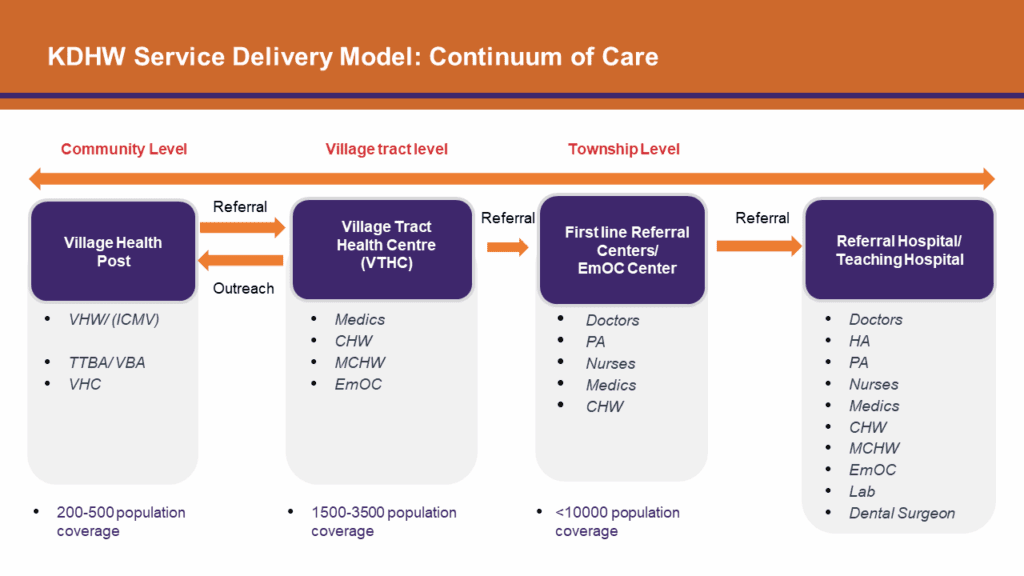
In 1998, due to developing political and military situations, the conventional health system was abandoned and a Mobile Health Care Program (MHCP) was practiced. Following the state level preliminary Bi-lateral Ceasefire Agreement in 2012, a more stationed health care system, designed on community-based, where each village has at least one Village Health Worker (VHW) and each village tract has one health center called Village Tract Health Center (VTHC) has been introduced. Currently, KDHW and its close partners have been providing Comprehensive Primary Health Care to more than 350,000 populations in hard-to-reach and conflict affected areas of Karen State and some parts of Mon State, Tanintharyi and East Bago Regions.
Welfare
The welfare sector is to ensure all populations in the KNU administrative area have equal rights to possess guaranteed life according to social protection standards. After 1997, the populations of Internally Displaced Peoples (IDPs) in Karen areas are significantly increased because of the big offensive of Burma Army knows as Tamadaw. They destroyed and buried the civilian villages including houses, food, plantation fields. Due to this, villagers were lost their properties and facing with food shortage. The welfare program is aim to provide social protection and well-being to Children, Women, Youth, Elderly, Disable, Orphan population. Moreover, Emergency relief, Long-Term Care and Psychosocial support included as part of the strategy. Currently, the welfare sector is providing humanitarian assistance, Mine Risk Education and Prosthetic workshop. Additionally, others programs were included such as Community Development and Relief Programs, Return, Resettlement and Reintegration Program, and Emergency Relief Assistance program and Awareness and Capacity Building Program.
Continuity of Care and Healthcare Services
There are four levels of KDHW continuity of healthcare services, including the community level, Village Tract Health Center (VTHC) level, Referral Center level, and Secondary Hospital level. These levels aim to ensure a seamless and coordinated approach to patient care across all stages of the health system. At the community level, basic health promotion and disease prevention activities are carried out by community health workers. The VTHC provides primary healthcare services and minor treatments. More complex cases are referred to the Referral Center, and critical or specialized care is provided at the Secondary Hospital level, ensuring effective service delivery for all.
KDHW Leaderships (1956-Present)

P' Doh Diamond Khin
(2020-Present)

P' Doh Eh Kalu Shwe Oo
(2012-2020)

P' Doh Roger Khin
(2000-2011)

P' Doh Dr. Marta
(1995-1999)

P' Doh San Lin
(1993-1995)

P' Doh Dr. Kho Thaw
(1991-1993)

P' Doh Than Aung
(1987-1991)

P' Doh Cha Lay
(1976-1986)

P' Doh Gay Dweh Bwah
(1974)

P' Doh Ba Tun
(1956-1963)
